
Slow Productivity for Grad Students
A Grad Student's Perspective on Slow Productivity by Cal Newport

Last week I finished reading the book Slow Productivity by Cal Newport. And I loved it. This book was a much needed perspective on productivity. Maybe productivity doesn’t need to be unhealthy. Now that I have had some time to process and write up my notes for the book, I thought I would share them with you. Here are my notes from the perspective of a grad student.
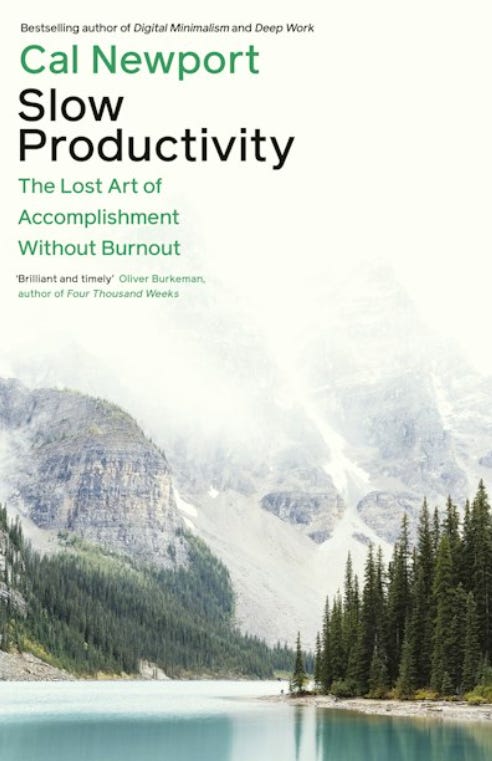
Slow productivity is a method of carrying out your work in a purposeful and sustainable way. Under the slow productivity lifestyle, work is completed holistically, rather than in a hectic manner. Your work should be meaningful, not a cause of burnout.
There are three principles of slow productivity which are:
Do fewer things
Work at a natural pace
Obsess over quality
Here’s how I plan to apply each principle in the upcoming semester at uni.
Do Fewer Things
This principle encourages us to reduce our obligations and projects. I liked this principle because in this day and age we are encouraged to always do more, be more, and have more. Unfortunately more is not always the answer. In doing fewer things the goal is to complete projects with time to spare. Being grad students we don’t really have a say in our workload. There are a set number of classes we need to take to pass each year.
That being said, we can apply some of the strategies mentioned in this chapter to our workload. Firstly, we can limit our daily goals. This strategy says to focus on one project each day. To apply this principle we can choose one class to focus on for each day of the week. This one project won’t be the only thing we work on each day. For a uni student we will still go to lectures and tutorials for other classes. However this one class will be the focus of the day and any ongoing assignments will be worked on during this day.
Another strategy we can apply as uni students is putting tasks on autopilot. Usually there are certain tasks that need to be completed every week during the semester. This could be reviewing the week’s lectures, or completing weekly quizzes. For these recurring tasks a specific time and location should be chosen to complete each one. By pairing these tasks with a specific time and location the overhead for these tasks is reduced. For example maybe you do your weekly quiz for Class A on Friday after lunch in the campus library. By combining a task with a time and location we are more likely to complete it without thinking about it.
Work at a Natural Pace
Working at a natural pace is about not rushing our most important work. Allowing work to unfold along a sustainable timeline with varying intensity. The pace of work at uni is somewhat already determined. We are given deadlines to complete work at the beginning of the semester and we work to make those deadlines. However, it is always the case that a lecturer sets an assignment due ten weeks from now and we are still working on it two hours before its due. I think we need to work at the natural pace we are given and start working on that assignment the day it is set (even if we just create a document and write our name at the top).
Another strategy introduced in slow productivity is embracing seasonality. This encourages us to work at varying intensities and schedule slow seasons in our workflow. The uni semester is already built nicely to embrace seasonality. The semester is broken up into 12 weeks of learning with a 2 week break in the middle and followed by a 3 week exam period. And this is only done twice a year. Seems like a pretty easy gig. We just have to work intensely during the semester and then can take the breaks to relax and explore other projects such as new hobbies or taking on internships. As a student you should pay attention to the natural semester cycles and make sure your work ethic and effort match the time of semester it is.
Additionally when you get a job after uni it could pay to try and mimic the university calendar of regularly scheduled breaks. It may not be possible to fully simulate a uni year in your job however this can be adjusted to fit the workflow of the job.
Obsess Over Quality
And we come to the final principle of slow productivity. This principle urges us to produce the best quality product even if it means missing out on opportunities in the short term, and then using those results to gain freedom in the long term. In the lens of a uni student this principle is very simple, get good grades and learn for your future, not just that semester. Then use that knowledge to gain opportunities such as research projects or a high paying job. Even if that means sacrificing certain social commitments during the semester, it will pay off in the long term.
A quote that I think is important for many uni students to hear is:
“A little quality work everyday will produce more and more satisfying results that frantic work piled on top of frantic work”
Work on that assignment today or start preparing for the test now. Deadlines will creep up on you fast so might as well get ahead of them and so a little work everyday.
Slow productivity is a wonderful guide to completing work (and designing a career). In this view work-life balance does not exist. Life has balance and work is just one part of that. And I think it's time to address that the work part of our lives should be a lot smaller than we’ve been treating it. This book is revolutionary and I will read it over and over again as I progress from a student to a working professional.
~ Polymath Jess xx